Is Tolantongo Worth It?
Yes — but not for everyone, and not on a Saturday. The honest case for and against Grutas de Tolantongo: the eight-hour round trip, the cash-only rule, the crowds, and who should go somewhere closer instead.
Short answer: yes, and the photographs are not exaggerating — the cliffside pools really do look like that. But Tolantongo asks more of you than almost any other day trip from Mexico City, and there is a specific kind of visitor who should not go.
The honest framing is this: you are not buying a hot spring, you are buying a canyon. Thermal water is common in central Mexico and there are hot springs an hour from the capital. What Tolantongo has that they do not is scale — a whole gorge where the water comes out of a cave, runs turquoise down a river, and fills forty pools bolted to a cliff face. That is why people drive four hours each way. If you would be equally happy in warm water anywhere, you are about to spend eight hours in a car for something you could get in one.
The one-line verdict
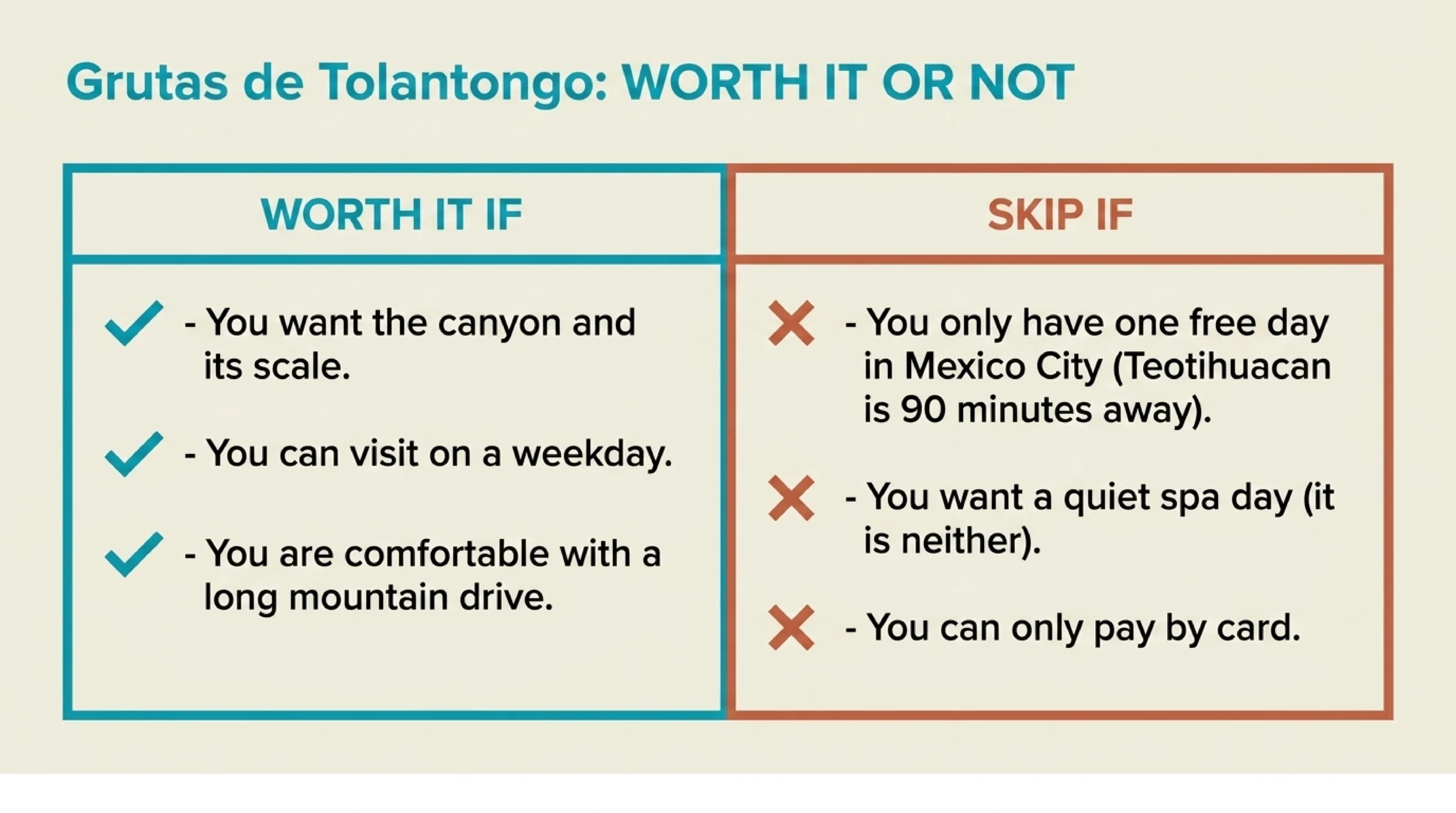
| Worth it if | You want the canyon and the scale, you can go on a weekday, and you’re comfortable with a long mountain drive |
| Skip it if | You only have one free day in CDMX, you want a relaxing spa day, or you need to pay by card |
| The cost | 230 MXN entry per person, cash only · guided day trips from around US$124 |
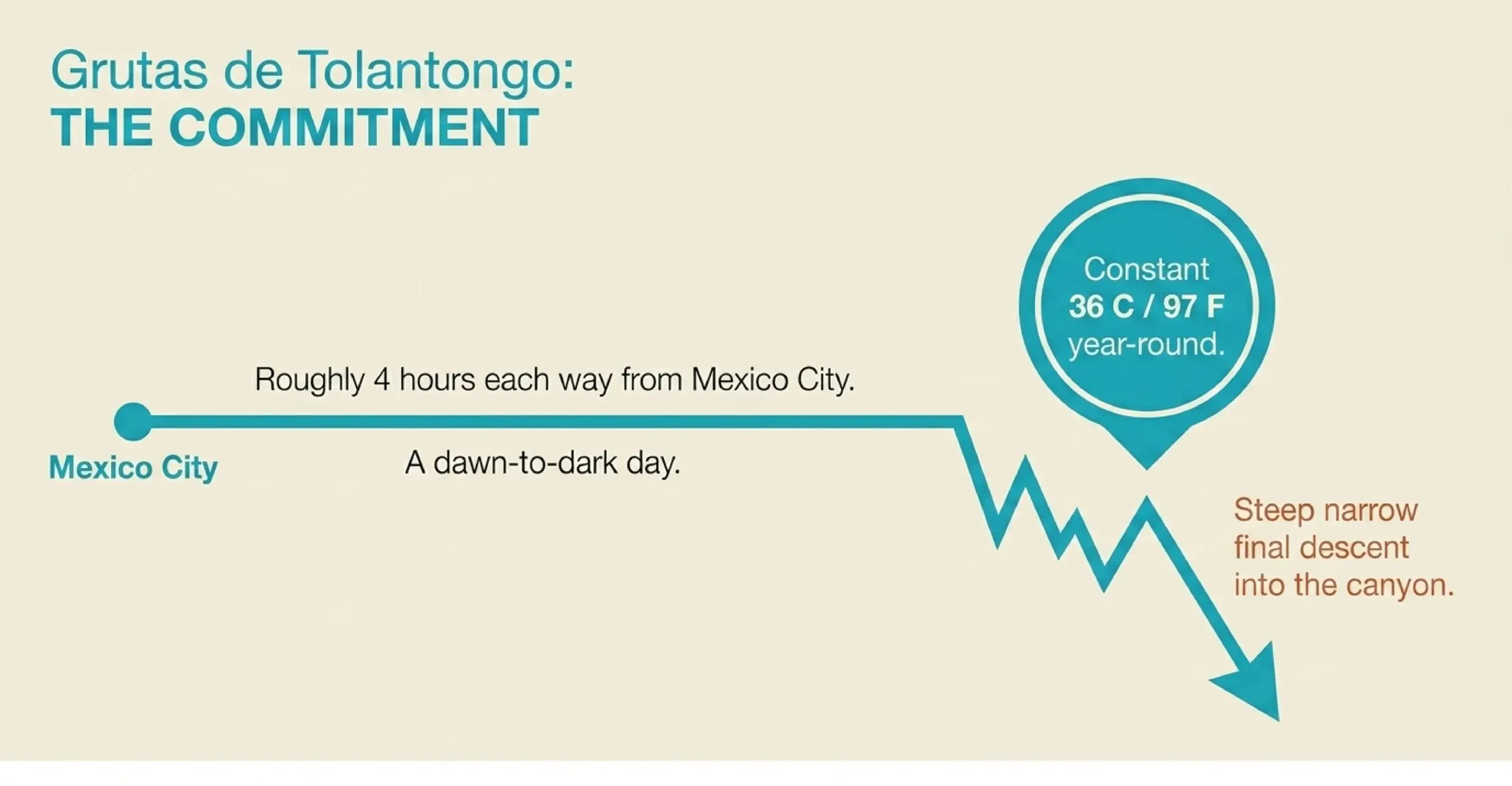
| The commitment | Roughly 4 hours each way from Mexico City — a genuine dawn-to-dark day |
What makes it genuinely special
The water comes out of a cave, and you can stand inside it. La Gruta is not a themed attraction — it’s a real cavern where hot mineral water sheets down the rock like natural showers, in near-darkness. El Túnel next to it is a low bore into the mountain you wade through in waist-deep hot water. Neither exists anywhere else in the region.
The river is actually that colour. The turquoise of the Río Tolantongo comes from dissolved minerals, not dye or filters, and it’s warm enough to swim.
The pozas earn their reputation. Thirty to forty terraced infinity pools stacked up a cliff, looking across the gorge. Whatever you have seen in photographs is roughly accurate — the surprise is how many there are and how high they climb.
And the entry price is not a typo. 230 pesos covers both caves, the river and every one of the pools — there is no per-pool or per-cave upcharge, which is genuinely remarkable value. (A handful of things do cost extra: the zipline is 300 pesos, and the internal shuttle, lockers and grill rental are all separate. The full price breakdown has the numbers.)
Ranking the canyon: what your ticket actually reaches
The single most useful thing to understand before you arrive is that Tolantongo is not one place. It is a canyon roughly three kilometres end to end, and the features are spread along its whole length. People picture a compact resort, park once, and then discover the cave is a long walk from the pools.
If your day has limited hours, spend them in this order:
- The pozas at Paraíso Escondido — included. The terraced cliff pools you came for, and the closest thing to the gate — about 200 m in. Do not rush here first thing: the pools are drained and cleaned in the morning and are typically not refilled until around midday. Visitors who arrive at dawn and head straight up regularly find them empty.
- La Gruta and El Túnel — included. The two hot-water caves, and the reason this place is not just another balneario. 1.6 km from the gate, up the canyon. See the hot springs guide for what each one is like inside.
- The river and the waterfall — included. The turquoise Río Tolantongo and the falls at the canyon head, where the thermal water emerges.
- The suspension bridge — included. Near the entrance, and the best free view down the gorge.
- The zipline (tirolesa) — 300 MXN extra, per person per launch. The full line runs 1,890 m across the canyon. Not included in your entry, whatever you may have read.
- La Gloria — 180 MXN separate. A different cooperative entirely, a further 2.9 km up-canyon, with its own gate and its own pools. Quieter, and a genuinely separate decision.
Red is the gate where you pay. Green is included in your 230-peso ticket. Gold costs extra. Tap a marker for detail, and zoom in at the canyon mouth and the head — several features sit within 200 m of each other and their markers overlap at this scale.
Look at the spread. Four of the six features cost nothing beyond the entry fee, which is the real value argument for this place — but they are strung along three kilometres of canyon floor, not clustered around the car park. That is why the park runs an internal shuttle (15–20 MXN a trip), and why people who plan to “just walk between everything” tend to see less than they hoped.
Who should honestly skip it
Anyone with only one spare day in Mexico City. This is the big one. Tolantongo is about four hours north, on a road that ends with a steep, narrow descent into the canyon. Round trip, plus time actually in the water, is a dawn-to-dark commitment. If you have a single free day and haven’t seen Teotihuacán, the pyramids are ninety minutes away and are the better use of it. A Mexico City food tour or the Xochimilco canals also fill a half-day without committing eight hours to the road. Come back for Tolantongo when you have more room.
Anyone wanting a quiet spa day. It is not a spa and it is not quiet. At midday on a weekend the pozas are full, the queues are real, and the soundtrack is families having a great time. That’s a fine day out — but it isn’t tranquillity, and visitors who arrive expecting serenity are the ones who leave disappointed.
Anyone who can’t bring cash. Everything inside the park is cash only — the gate, the restaurants, the cabins. No ATM in the canyon. Arriving with only a card is the single most common way to ruin the day.
Anyone nervous on mountain roads. The final descent is steep with switchbacks and drops. If that description makes you tense, take a guided trip and let someone else drive it — that’s a good reason to book a tour rather than a reason to stay home.
What nobody tells you before you go
Most Tolantongo guides are written from a press trip or a single sunny visit. These are the things that come up repeatedly in first-hand visitor reports and almost never in the guides. To be fair about where they come from: Tolantongo averages a shade above four stars, and the warnings below are drawn from the minority of critical reviews. They are real, specific, and worth knowing — but they are not the median day.
The ticket runs to 8pm; the attractions do not. This is the one that costs people the most. Entry is valid 07:00–20:00, but the caves and the waterfall shut around 5pm and most of the pools around 6pm. Lockers close at 5pm too — with your things inside. An afternoon arrival buys you far less than the ticket window suggests.
The pools are drained in the morning. They are cleaned overnight and typically refill around midday. The near-universal advice to “arrive early to beat the crowds” is right about the crowds and wrong about the pools — arrive early and do the caves and the river first.
The cave and the tunnel are the warmest water, not the pozas. Nearly everyone assumes the famous cliff pools are the hot part. They are the coolest, and the higher terraces are warmer than the lower ones. Expect body temperature rather than spa temperature — “lukewarm” is the most common complaint in the reviews, and it is an expectations problem more than a water problem.
El Túnel is pitch dark — bring a light. There is no lighting inside beyond what reaches the entrance. A rope guides you through the darkest stretch. It is also hot, humid and narrow; several visitors describe it as genuinely claustrophobic, and at least one had to turn back. If small spaces bother you, this is the one feature to skip.
Backpacks get stopped after the climb, not before. The sign about food and drink sits near the entrance, but the actual bag restriction is enforced further in — at a point you reach only after a substantial climb, where lockers happen to be available. Several visitors describe going up, being turned back, and paying for a second locker. Travel light from the car.
Food comes in on your first entry only. You may bring your own food and non-alcoholic drinks, but the park’s own rules say that if you leave and come back, you cannot bring food in on re-entry. Alcohol and glass are prohibited outright, and enforcement is real.
It is stairs, everywhere. The canyon is steep and the connections between areas are long flights of steps. Visitors consistently describe it as physically demanding, and one counted a grand total of two ramps in the whole park. If anyone in your group has limited mobility, take this seriously — it is the single most repeated physical complaint.
Water shoes help and do not solve it. The walkways are wet and slippery, and staff hose them down mid-morning while people are walking on them. One reviewer’s 78-year-old father fell and hurt his arm while wearing water shoes. Move deliberately.
Bring your passport, even though this is a domestic day trip. Two of the largest operators state it plainly in their booking conditions: because of government immigration regulations, every guest must present a passport — digital, original or photocopy — and a copy is accepted. It catches people out precisely because nobody expects a document check on a trip that never leaves Mexico. If you are booking a guided trip, check that operator’s conditions and put a photo of your passport on your phone.
There is effectively no phone signal, and only one network. Telcel gets some reception; nothing else does. Screenshot anything you will need — bus times, your booking, directions — before you drop into the canyon.
The showers have no boiler. Room showers run on river water, so “hot shower” means roughly the temperature of the pools outside. Pack accordingly if you are staying over.
The road is paved now — but that is not the problem. Older guides warn about eight kilometres of dirt track; that was true a decade ago and the paving finished years back. What has not changed is the geometry: tight switchbacks, steep gradients and no barriers on the drops. It is a road that demands low gear and attention, not a four-wheel drive.
Is Tolantongo safe?
Broadly yes, with ordinary caution. The park runs its own security and first aid, the pools are well established, and it is a mainstream domestic destination — the visitors around you will mostly be Mexican families. The genuine risks are practical rather than sinister: the road, especially after dark or in rain; the water, which is deep in places and has currents in the river; and the heat, since long soaks in 36 °C water dehydrate you faster than you’d expect. Bring more drinking water than feels necessary.
When it stops being worth it
Timing changes the answer more than anything else. The same 230 pesos buys a wonderful day or a frustrating one:
- Weekday, from midday — the version everyone hopes for: pools refilled, cave quiet. Note that a midweek visit also means reduced service — some restaurants shut, the water slides may not run, and the internal shuttle often waits for six passengers before it moves.
- Weekend midday, peak season — the crowded version. Expect to queue and to share.
- Rainy season — the river can run brown rather than turquoise, which removes one of the three reasons to come.
Our best time to visit guide covers the seasonal detail. If your only option is a peak weekend, consider La Gloria — the separate cooperative further up the canyon, with its own pools and far fewer people.
Going? These are the two most-booked day trips:
Small-group day trip from Mexico City
The most-booked option by a wide margin. Round-trip transport, a bilingual guide and the park gate handled — which also solves the cash-only problem.
Check availability →Small-group tour from CDMX
The cheapest guided option with a real review base. Same long day, same canyon, slightly smaller price — worth comparing departure times before you pick.
Compare this tour →So — is it worth it?
Yes, if you treat it as a full-day expedition rather than an outing, and ideally not on a weekend. The canyon is genuinely one of the more extraordinary places within reach of Mexico City, and the entry price is a bargain for what’s inside the gate. The expensive part is the day it costs you, not the ticket.
If you’re going, the practical decision is whether to drive or take a guided trip — the price breakdown works through both, and the route guide covers the drive itself.
Park entry and tour prices checked July 2026. Park payments are cash only.
See Tolantongo Without the 4-Hour Drive Each Way
The top-rated small-group day trip handles the long round-trip from Mexico City, the park gate, and a bilingual guide — so you can spend the day in the caves, river and cliffside pools. Rated 4.6/5 by 654 guests. Free cancellation.
Check Availability & Book